
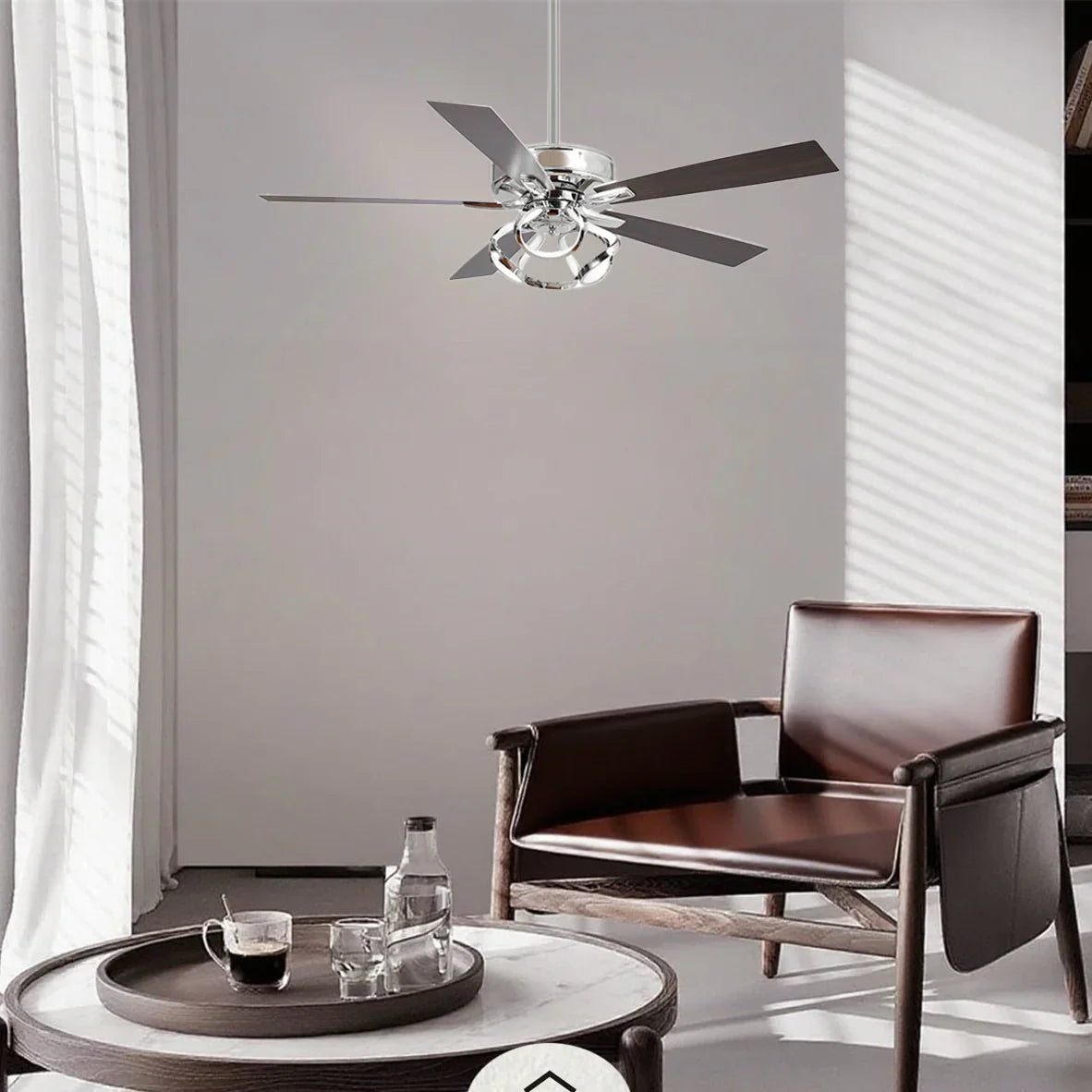





A lot of American shoppers assume the answer is yes. It sounds logical. If a fan has more blades, it should move more air. In real life, it does not work that way. A 6-blade ceiling fan does not automatically move more air than a 5-blade fan. In the U.S. market, airflow depends much more on fan size, blade pitch, blade shape, motor performance, and installation height than on blade count by itself. Current U.S. buying guidance and manufacturer engineering guidance both make that point very clearly.
That is why two fans can look similar from across the room but perform very differently once you check the specs. A well-designed 5-blade fan can beat a 6-blade fan on airflow. A 6-blade fan can also beat a 5-blade fan. The difference usually comes from the whole fan system, not the extra blade alone. If you want a simple way to judge performance, start with CFM, which means cubic feet per minute, because that tells you how much air the fan moves in one minute. Federal efficiency criteria use airflow and CFM per watt as core performance measures for ceiling fans.
Parrot Uncle is a U.S.-based home brand best known for ceiling fans, and lighting solutions that improve comfort and elevate the look of everyday spaces.For most U.S. homes, the better question is not "How many blades does it have?" The better question is "Is this fan the right size for my room, and does its airflow rating match what I need?" That is how American buying guides frame the decision, and it is a much better way to shop whether you are outfitting a bedroom, living room, open-concept family room, or covered patio.

Why this question confuses so many buyers
The confusion usually starts with a very simple idea: more blades should mean more air. That sounds sensible, but airflow is not just about how many surfaces are spinning. It is about how efficiently the whole fan moves air through the room. One current engineering guide from a major U.S. manufacturer says the number of blades is not necessarily an indicator of airflow, while blade pitch and blade shape can have a real impact. The same source also says motor performance and the distance from the ceiling and floor affect how the fan actually performs.
Another current U.S. buying guide says much the same thing in even plainer words. It says the look of the blades is more of a design feature than a matter of efficiency or utility, and that a fan's ability to move air is determined by blade pitch. That does not mean blade count is meaningless. It does mean blade count is not a reliable shortcut for airflow.
Federal guidance also pushes buyers in this direction. Ceiling fan efficiency standards are tied to fan diameter and airflow, not blade count. For standard residential ceiling fans under 78 inches, the minimum airflow requirement rises with diameter. That alone tells you something important: the market and the standards treat size and measurable airflow as the real performance signals, not the number of blades.
So when people ask whether 6 blades move more air than 5, the most accurate answer is this: sometimes yes, sometimes no, and blade count alone will not tell you which one wins. You have to read the spec sheet.
Airflow starts with the whole fan, not just the blade count
The first major factor is fan size. U.S. room-sizing guidance says rooms up to 225 square feet usually need a fan up to 51 inches, large rooms up to 400 square feet usually fit a 52 to 59 inch fan, and great rooms over 400 square feet often need a 60 to 71 inch fan. Federal energy guidance adds that for larger rooms, fans 52 inches or more are the right starting point, and rooms longer than 18 feet often work better with more than one fan. That means a larger 6-blade fan often posts higher airflow simply because it lives in a larger-room category, not because the sixth blade is doing all the work.
The second major factor is blade pitch and blade design. U.S. guidance says blade pitch directly affects how much air is produced. Manufacturer guidance also says contoured and aerodynamic blades can push air more efficiently than flatter designs. This is one reason why two fans with the same size and a similar blade count can still feel very different in use. The geometry matters.
The third major factor is the motor. A ceiling fan only performs as well as the motor turning the blades. Current U.S. retail guidance says DC fans generally use less energy, offer more speeds, and are often quieter, while AC fans are more common and often simpler. That does not mean every DC fan has stronger airflow than every AC fan, but it does mean motor design is far more important than one extra blade.
The fourth major factor is installation height. U.S. room guidance says the ideal height from the floor to the blades is about 8 feet. Federal guidance says ceilings should be at least 8 feet high and that larger blades move more air at lower velocities. A fan that is installed too high, too low, or too close to the ceiling may not deliver the airflow you expect, no matter how many blades it has.
The fifth factor is how the air feels, not just how it measures. Ceiling fans cool people, not rooms. Federal guidance says fans create a wind chill effect and can let you raise the thermostat by about 4 degrees Fahrenheit without losing comfort. That means the best fan is not only the one with the biggest airflow number. It is the one that gives you usable airflow where you actually sit, sleep, or spend time.
What 6 blades can do well
A 6-blade fan can make a lot of sense in a large American room. It often comes in a larger diameter, with a motor and blade system designed for broad, even airflow across more square footage. Brand collection pages also tend to position 6-blade fans this way. One current brand collection describes 6-blade models as a strong fit for modern interiors, living rooms, bedrooms, and open layouts, with a feel that is more substantial and better suited to larger spaces.
In practical terms, a 6-blade fan often shows up when a manufacturer is building a fan for a great room, a loft, or an open-concept living space. In that setting, the extra blade may be part of a broader design choice that includes a larger span, a stronger motor, and a blade shape tuned for wide, steady circulation. That can absolutely lead to higher airflow. But the point is that the larger airflow usually comes from the whole package, not the blade count by itself.
This is why a 6-blade fan can feel like the right answer in a large family room, but the same logic does not always carry over to a typical bedroom or smaller living room. Once the room size changes, the best fan can change too.

What 5 blades still do very well
A 5-blade fan remains one of the most common and practical choices in American homes. Current brand guidance frames 5-blade fans as a balanced, classic option with steady everyday airflow. In many bedrooms, living rooms, home offices, and dining spaces, that is exactly what people want. A 5-blade fan can offer plenty of airflow, a familiar look, and a size that fits a wide range of room types.
In other words, 5 blades are not some weaker category that buyers settle for. They are often the standard format because they work well in real homes. If the fan has the right pitch, the right motor, and the right diameter, a 5-blade model can move a lot of air. U.S. buying guidance treats that performance question as a matter of pitch, size, and motor design, which is exactly why so many 5-blade models still perform strongly.
This also explains why a 5-blade fan is often the smarter pick in medium-size rooms. A larger 6-blade unit may look impressive, but if it is more fan than the room needs, it can be the wrong tool for the space. American buying guides repeatedly warn that a fan that is too large can overpower a room, just as a fan that is too small will not circulate air effectively.
A simple comparison
| Question | 5-blade fan | 6-blade fan |
|---|---|---|
| Does it automatically move more air | No | No |
| What matters more | CFM, span, pitch, motor, height | CFM, span, pitch, motor, height |
| Where it often fits | Bedrooms, living rooms, many standard home spaces | Larger living rooms, open layouts, great rooms |
| Main buyer mistake | Assuming it is weaker because it has fewer blades | Assuming the extra blade alone guarantees more airflow |
That table matches the basic pattern in current U.S. guidance. Blade count matters much less than measurable airflow, room fit, and fan design.
How to compare two fans without guessing
If you want the stronger airflow, check CFM first. That gives you the clearest direct answer on how much air the fan moves at high speed. Current federal criteria use airflow as a core part of ceiling fan performance, and U.S. buying guides define CFM as the standard measure of how much air a fan moves in one minute.
Then check the fan size. A high CFM number on a fan that is too small for your room may still leave dead spots. Conversely, a bigger fan with more airflow may not be the best choice if the room is not large enough for it. U.S. room-size guidance is very clear on this point.
After that, check blade pitch and motor type. If the product page lists pitch, it is worth paying attention to. If it lists a DC motor, that usually means more speeds and better efficiency, though not automatically better airflow. Finally, make sure the fan will be mounted at the right height. These are the details that actually determine comfort.
What the current Parrot Uncle lineup suggests
The current brand lineup is useful because it presents 5-blade and 6-blade fans as different kinds of solutions, not as a simple good-better ladder. Its 5-blade collection describes those fans as a classic, balanced option with steady airflow for everyday living. Its 6-blade collection presents those fans as a stronger fit for modern and open layouts with a more substantial feel and smooth airflow. That brand positioning already suggests that blade count is tied to room type and design approach, not just raw airflow claims.
The broader collection page also emphasizes the features American shoppers usually care about most: remote control, reversible operation, LED lighting, and a range of sizes for different rooms. That matches the way U.S. buying guides tell people to shop. The fan has to fit the room first. Then it has to deliver the control, lighting, and circulation you actually need.
52" Indutrial 5 Blades Ceiling Fan with LED Lighting
A good current 5-blade example is the 52 inch Industrial 5 Blades Ceiling Fan with LED Lighting. The current product page lists a 52 inch span, 5 blades, a 12 degree blade pitch, a maximum airflow of 4687 CFM, an AC motor, and a recommended room size of up to 350 square feet. It also includes integrated LED lighting at 1500 lumens and 3000K, with remote control.
This fan is a strong example of why 5-blade models still make sense in so many U.S. homes. It sits in the classic 52 inch range that works for a lot of bedrooms, living rooms, and family rooms, and its 4687 CFM rating is already a solid airflow figure for that class. It shows that a 5-blade fan can move plenty of air when the span, blade pitch, and motor are designed well.
It also shows why counting blades can be misleading. If you only looked at the blade count, you might assume this fan has less airflow than any 6-blade option. But once you check the published airflow rating, you can see it is already doing serious work in a common residential size.

65'' Inch Freda DC Motor Modern Ceiling Fan
A useful 6-blade example is the 65 inch Freda DC Motor Modern Ceiling Fan with LED Light and Remote Control. The current product page lists a 65 inch span, 6 aluminum blades, a 40 watt DC motor, 6549 CFM airflow, 2376 lumens, 3000K lighting, and a recommended room size of more than 350 square feet. It also says the fan runs at up to 90 RPM and is meant for dry indoor use.
This fan clearly posts higher airflow than the 52 inch 5-blade example above. But it is also a larger fan, intended for a larger room, with a different motor and a different blade system. That is the whole point. The higher airflow in this case is real, but it does not prove that six blades alone caused it. It proves that a larger, large-room fan with a different design can move more air.
From a buying standpoint, this is actually helpful. It shows what happens in the real U.S. market. Larger 6-blade fans often live in the bigger-room category and carry bigger airflow numbers. Smaller or mid-size 5-blade fans often cover the more common room sizes and still deliver strong circulation. The right answer depends on the room you are trying to cool.

A direct product table
| Product | 52 inch Industrial 5 Blades Ceiling Fan with LED Lighting | 65 inch Freda DC Motor Modern Ceiling Fan with LED Light |
|---|---|---|
| Blade count | 5 | 6 |
| Fan span | 52 inches | 65 inches |
| Published airflow | 4687 CFM | 6549 CFM |
| Motor | AC motor | DC motor |
| Recommended room size | Up to 350 sq ft | More than 350 sq ft |
| Lighting | 1500 lumens, 3000K | 2376 lumens, 3000K |
This table gives a clean real-world lesson. Yes, the 6-blade product moves more air here. But it is also larger, built for a bigger room, and based on a different motor setup. It is not a pure blade-count experiment, and that is exactly why shoppers should be careful with simple assumptions.
So do 6-blade ceiling fans move more air than 5-blade fans
Not by default. A 6-blade ceiling fan can move more air than a 5-blade fan, but that is usually because the whole design supports stronger airflow. The fan may be larger, use a different pitch, run a different motor, or be built for a bigger room. U.S. buying guides, federal efficiency criteria, and manufacturer engineering guidance all point to the same conclusion: blade count alone is not a reliable predictor of airflow.
If you want the best answer for an actual purchase, ignore the blade count at first. Check CFM. Check room size. Check blade pitch if it is listed. Check motor type. Check the mounting height. Then decide whether the fan fits the room and your comfort goals. That is a much more accurate way to shop than assuming a sixth blade automatically means more breeze.
From the current Parrot Uncle examples, the lesson is straightforward. The 65 inch 6-blade Freda model does post higher airflow than the 52 inch 5-blade Industrial model, but that result lines up with its larger size and larger-room role. It does not prove a universal rule about blade count. It proves something more useful: the fan that moves more air is the fan with the stronger overall airflow design for the room it is meant to serve.

