

Straight blades and curved blades can both work well on outdoor ceiling fans. The better choice depends on the patio size, ceiling height, motor strength, blade pitch, blade material, weather rating, and how much airflow you want. Blade shape matters, but it is not the only thing that decides performance.
For most outdoor spaces, the best fan is not simply the one with the most curved blades or the widest rectangular blades. The best fan is the one that moves enough air for the space, holds up outdoors, runs quietly, and looks right with the patio, porch, pergola, or covered deck.
In simple terms, straight blades often fit modern outdoor spaces and can deliver clean, steady airflow when paired with the right motor and pitch. Curved or airfoil inspired blades can also perform well because their shape is designed to guide air more smoothly. But neither style is automatically better in every setting.
Parrot Uncle is a U.S.-based home brand best known for ceiling fans, and lighting solutions that improve comfort and elevate the look of everyday spaces.From the Parrot Uncle point of view, outdoor fan performance should be judged by the full fan, not by blade shape alone. A good outdoor ceiling fan should combine durable materials, weather resistance, useful CFM, a reliable motor, and a blade design that suits the space.

Quick Answer
Straight blades are not always better. Curved blades are not always better either. For outdoor ceiling fans, the best blade shape is the one that works with the fan motor, blade pitch, blade span, speed settings, and outdoor rating.
A straight blade fan can be a strong choice for a covered patio, modern porch, outdoor kitchen, or clean architectural space. A curved blade fan can be a strong choice when the fan is designed for smooth airflow and a softer visual look.
When comparing outdoor ceiling fan blades, focus on three things first.
- CFM airflow rating.
- Outdoor rating and blade material.
- Blade pitch and motor quality.
ENERGY STAR explains that higher blade pitch usually moves more air, but blade pitch alone does not determine air movement. Motor design, motor speed, blade material, blade number, blade length, and overall blade design also matter.
What Blade Shape Really Does
Blade shape affects how the fan pushes air. A blade is not just a flat decoration. It is the part of the fan that cuts through air and moves it downward or around the space.
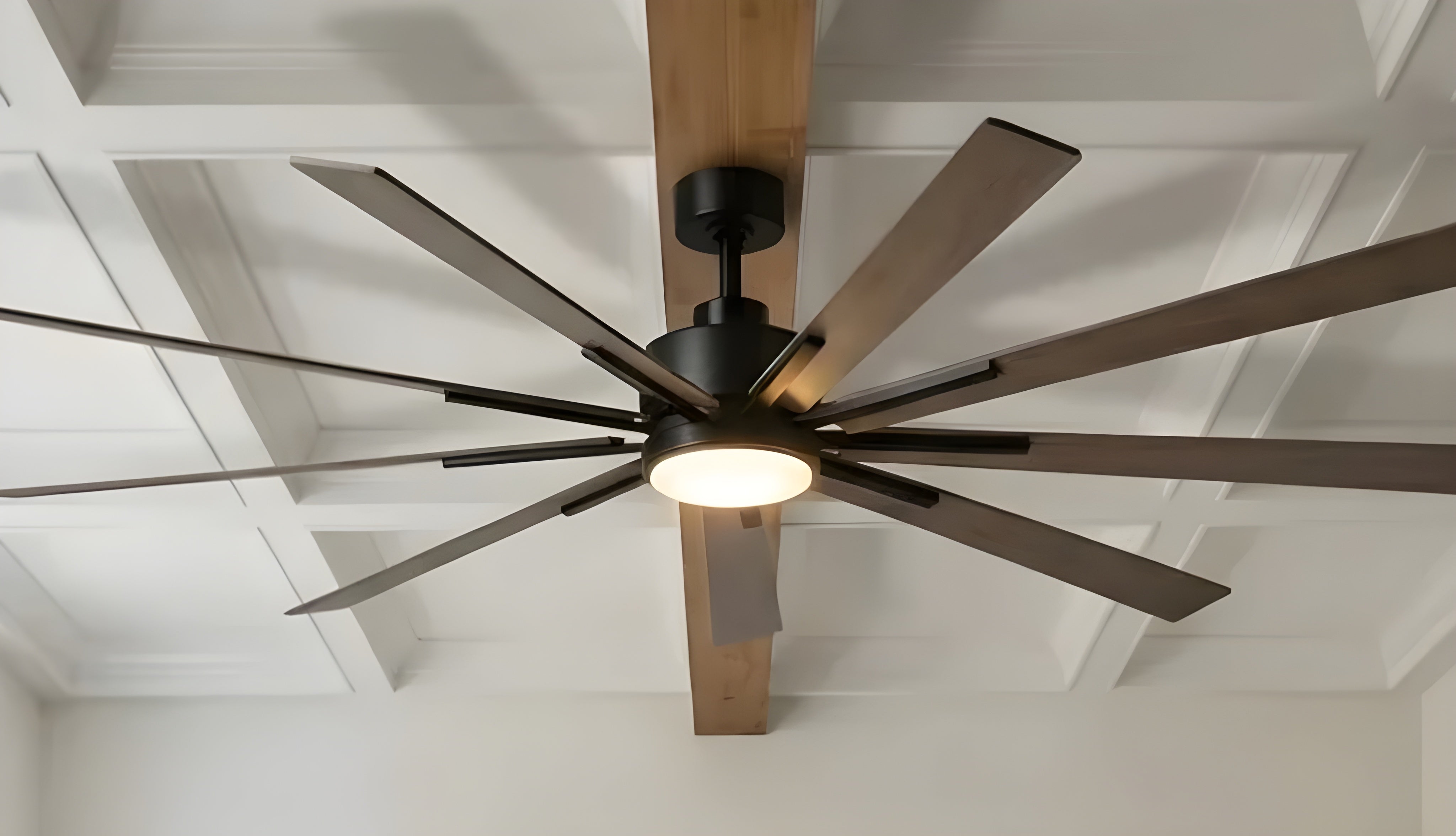
A straight blade usually has a clean, simple edge. It often looks rectangular or slightly tapered. This shape is common in modern, industrial, and minimalist outdoor fans. It can work very well when the fan has a strong motor and proper blade pitch.
A curved blade has a more sculpted shape. It may look like an airfoil, wave, palm leaf, or gently bent blade. This can help guide airflow in a smoother way, depending on the engineering of the fan. It can also make the fan look softer or more decorative.
The important point is that blade shape works as part of a system. A curved blade with a weak motor may perform worse than a straight blade with a strong motor. A straight blade with poor pitch may move less air than a well designed curved blade. You need to compare the full fan.
Straight Blades
Straight blades are popular because they look clean and work with many outdoor home styles. They are common on modern patio fans, farmhouse fans, industrial fans, and large outdoor fans. They can look especially good under a flat patio roof, covered deck, or modern pergola.
Straight blades often feel simple and balanced. They do not add much visual movement when the fan is off, which is useful if you want the patio ceiling to look neat.
| Straight blade benefit | Why it matters outdoors |
|---|---|
| Clean look | Works with modern patios, decks, and outdoor kitchens |
| Easy style match | Fits black, white, wood look, or metal finishes |
| Often easy to clean | Simple blade surfaces collect less visible detail |
| Good for large fans | Long straight blades can move a lot of air when designed well |
| Less decorative clutter | Good for simple outdoor spaces |
Straight blades are a good choice when you want the fan to blend with the structure of the space. They can look sharp with black window frames, metal patio furniture, concrete floors, outdoor kitchens, and clean wood ceilings.
The downside is that not all straight blades are high performance. A flat rectangular blade with poor pitch may look strong but move less air than expected. This is why you should always check CFM, blade pitch, motor type, and room size guidance.
Curved Blades
Curved blades can look more shaped, more fluid, and sometimes more tropical. They may be slightly twisted, tapered, sculpted, or airfoil inspired. On outdoor fans, curved blades can add style and help the fan feel less boxy.
A curved blade can move air very well when it is designed as part of a strong fan system. The curve may help guide air more smoothly, but the fan still needs the right motor, pitch, span, and speed range.
| Curved blade benefit | Why it matters outdoors |
|---|---|
| Softer look | Works well on porches, sunrooms, and relaxed patios |
| Airfoil style | Can support smooth airflow when engineered well |
| Decorative feel | Good for coastal, tropical, or casual outdoor rooms |
| Less rigid appearance | Helps soften hard outdoor surfaces |
| Style variety | Available in palm, wave, carved, and sculptural shapes |
Curved blades are often chosen for style as much as airflow. They can make a porch feel more relaxed and less industrial. They can also pair well with wicker seating, wood ceilings, stucco walls, tile floors, and outdoor living rooms.
The downside is that curved blades can be harder to compare by looks alone. Some decorative curved blades are designed more for style than airflow. Again, CFM and outdoor rating matter more than the shape description.
Straight Vs Curved
Here is the most practical way to compare them.
| Feature | Straight blades | Curved blades |
|---|---|---|
| Best look | Modern, industrial, farmhouse, minimalist | Coastal, tropical, casual, sculptural |
| Airflow potential | Strong when paired with good pitch and motor | Strong when properly engineered |
| Cleaning | Usually simple | May have more curves or detail to dust |
| Visual weight | Often clean and architectural | Often softer and more decorative |
| Best space | Covered patios, decks, outdoor kitchens | Porches, sunrooms, relaxed outdoor seating |
| Main risk | Can look plain or perform poorly if poorly pitched | Can be more style focused than performance focused |
The better question is not whether straight or curved blades win. The better question is which blade shape works best with the whole fan and the space where it will be installed.
For a small covered porch, a compact fan with curved blades may look warm and inviting. For a large patio, a long straight blade fan with strong CFM may be more practical. For a modern outdoor kitchen, straight blades may look cleaner. For a coastal seating area, curved blades may feel more natural.
CFM Matters More Than Shape
CFM means cubic feet per minute. It tells you how much air the fan can move. If you are comparing outdoor ceiling fans, CFM is one of the most useful numbers to check.
Outdoor areas often need more airflow than indoor rooms because the air is not contained the same way. A breeze can escape into the yard. Heat can build under a covered patio roof. Humidity can make the space feel heavy. A fan with weak CFM may spin but not give enough comfort.
ENERGY STAR uses CFM and CFM per watt to measure ceiling fan airflow and efficiency. CFM per watt shows how much airflow a fan produces for each watt of power used.
| Outdoor area | Practical airflow need |
|---|---|
| Small covered porch | Moderate CFM may be enough |
| Standard patio | Look for balanced CFM and low speed control |
| Large covered deck | Higher CFM is usually better |
| Outdoor kitchen | Strong airflow helps with heat, but placement matters |
| Open pavilion | Larger blade span or multiple fans may be needed |
A fan with curved blades and low CFM may not feel strong outdoors. A fan with straight blades and high CFM may feel much better. The CFM number gives you a clearer performance clue than blade shape alone.
Blade Pitch Is Key
Blade pitch is the angle of the blade. It affects how much air the blade can move as it rotates. A blade with more pitch can often move more air, but the motor must be strong enough to handle the resistance.
ENERGY STAR notes that higher blade pitches usually move more air, but also warns that pitch alone does not determine airflow. Other factors include motor design, motor speed, blade design, material, number, and length.
This matters because shoppers sometimes see a blade that looks wide or curved and assume it must move more air. That is not always true. If the pitch is shallow, the blade may slice through the air without moving much of it downward. If the pitch is steep but the motor is weak, the fan may struggle.
For outdoor fans, look for a blade pitch that works with the fan size and motor. For example, the Parrot Uncle Rhine 42 inch model lists a 17 degree blade pitch, while the Winni 72 and 84 inch model lists a 9 degree blade pitch. Those numbers should be read with the full specs, including blade span, motor power, and CFM.
Blade Span Changes Everything
Blade span is the width of the fan from one blade tip to the opposite blade tip. A 42 inch fan and an 84 inch fan are not trying to solve the same problem. The blade shape may look similar, but the coverage is very different.
For outdoor spaces, blade span should match the area you want to cool. A small porch does not need a giant fan. A large covered patio may feel underpowered with a compact fan.
| Outdoor space | Common fan size direction |
|---|---|
| Small porch | 36 to 44 inches |
| Medium covered patio | 44 to 60 inches |
| Large patio or deck | 60 to 72 inches |
| Oversized pavilion | 72 inches or larger |
| Long outdoor room | Two fans may work better than one |
A larger straight blade fan may move more air than a smaller curved blade fan simply because it has more blade span and more coverage. This is why comparing only shape can be misleading.
If you want comfort across a dining area, seating area, or outdoor kitchen, measure the space first. Then choose blade span and CFM. Shape comes after performance basics.
Outdoor Rating Comes First
For outdoor fans, the rating matters before the blade shape. A good looking fan with the wrong rating can fail early or become unsafe.
Outdoor ceiling fans may be described as damp rated, wet rated, waterproof, or weather resistant. The exact wording and rating should be checked on the product page. A fan used under a fully covered porch has different exposure than a fan installed where wind driven rain can reach it.
Parrot Uncle notes that outdoor ceiling fans should be checked for specific damp, wet, or dry location ratings to make sure the fan is used properly. The brand also describes its outdoor fans as built with weather resistant materials for covered patios, decks, and outdoor kitchens.
| Location | Better fan direction |
|---|---|
| Fully covered porch | Outdoor rated fan suitable for covered use |
| Covered patio with side rain | Stronger weather resistance is useful |
| Open pergola | Wet rated or waterproof rated fan may be needed |
| Outdoor kitchen | Outdoor rated fan with durable blades |
| Coastal area | Check corrosion resistance carefully |
Do not install an indoor only fan outdoors just because the blades look strong. Outdoor heat, humidity, moisture, and wind can damage the motor, finish, blades, and hardware.
Blade Material Matters Outdoors
Outdoor blades need to handle moisture and temperature changes. ENERGY STAR notes that blades should be sealed from moisture to prevent warping, bubbling, or peeling.
Common outdoor blade materials include ABS, aluminum, and treated or sealed materials. ABS is often used because it is lightweight and moisture resistant. Aluminum can work well for larger industrial outdoor fans because it is strong and stable. Wood look finishes can be attractive, but the actual material and outdoor rating matter more than the appearance.
| Blade material | Outdoor value |
|---|---|
| ABS | Lightweight, practical, moisture resistant |
| Aluminum | Strong, stable, good for large outdoor fans |
| Sealed composite | Can offer wood look with better durability |
| Natural wood | Needs proper sealing and suitable location |
| Indoor MDF | Usually not ideal outdoors unless rated for that use |
Blade material can matter more than whether the blade is straight or curved. A well rated ABS curved blade can be better outdoors than a straight indoor blade. A powder coated aluminum straight blade can be better for a large pavilion than a decorative blade made for indoor use.

Number Of Blades
Outdoor ceiling fans commonly have three, four, five, six, or more blades. More blades do not automatically mean more airflow. Blade number affects style, balance, sound, and air movement, but it works with motor power, pitch, and span.
A three blade outdoor fan often looks modern and can feel clean and efficient. A five blade fan can look more traditional or balanced. A large industrial fan may use long narrow blades to cover a wide space.
| Blade count | Common look |
|---|---|
| 3 blades | Modern, simple, often efficient looking |
| 4 blades | Balanced, transitional |
| 5 blades | Classic, familiar, stable look |
| 6 or more blades | Industrial, windmill, decorative, large coverage |
Do not choose by blade count alone. Check CFM, speed settings, motor type, blade span, and outdoor rating. A three blade fan can outperform a five blade fan if it has better engineering. A five blade fan can be the better choice if it suits the room and delivers the airflow you need.
Speed Control Changes Comfort
Outdoor comfort changes throughout the day. A patio may need high speed in the afternoon and low speed at dinner. A porch may only need gentle airflow in the evening. A fan with multiple speeds gives you control.
This is important because high airflow is useful, but too much airflow can be annoying. Strong wind can disturb napkins, plants, candles, or lightweight table settings. On a covered patio, you may want a fan that can move a lot of air when needed but also run gently when people are eating or relaxing.
Look for a fan with several speed settings and a remote control. The Parrot Uncle Rhine and Winni models both list 6 fan speeds. The Rhine includes a remote control set, and the Winni includes remote control with timer and memory function.
DC Motor Or AC Motor
For outdoor fans, the motor matters. A DC motor is often used in modern ceiling fans because it can offer efficient operation, smooth speed control, and quiet performance. AC motors can still be reliable, but many newer outdoor models use DC motors.
A strong motor is especially important when blades are wide, long, steeply pitched, or exposed to outdoor conditions. If the motor is underpowered, the blade shape will not save the fan.
ENERGY STAR explains that motor housing quality and internal components can affect vibration, stability, quiet operation, and long term performance.
For outdoor use, choose the fan as a full system.
- Motor.
- Blade design.
- Weather rating.
That combination matters more than a simple straight versus curved decision.
Covered Patio Vs Open Outdoor Area
Outdoor fan placement changes the decision. A covered patio is different from a pergola. A screened porch is different from an open deck. A fan under a roof may be protected from direct rain, while a fan under an open structure may face much harsher conditions.
| Outdoor location | Best fan priorities |
|---|---|
| Covered patio | Damp or outdoor rating, quiet motor, style |
| Screened porch | Airflow, easy cleaning, insect comfort |
| Outdoor kitchen | Heat control, durable materials, proper placement |
| Pergola | Wet or waterproof rating if exposed |
| Pavilion | Larger blade span and higher CFM |
| Coastal patio | Corrosion resistant materials and finishes |
For a covered patio, straight or curved blades can both work. For an open area, the outdoor rating and weather resistance become much more important. If rain can reach the fan, check the rating carefully before buying.
Do Straight Blades Move Less Air?
Not necessarily. Straight blades can move a lot of air when they have the right pitch, length, motor speed, and blade material. Many large outdoor fans use long straight blades because they provide clean coverage over wide spaces.
The idea that rectangular blades are only for style is too simple. A straight blade can be highly effective when it is designed correctly. A flat blade with poor pitch may be weak, but that is a design issue, not a straight blade issue.
For example, the Parrot Uncle Winni outdoor fan uses 5 aluminum blades and is available in 72 inch and 84 inch sizes. The product page lists 8237 CFM for the 72 inch option and 9598 CFM for the 84 inch option. That shows how a large straight blade style fan can be built for strong outdoor airflow.
Do Curved Blades Move More Air?
Sometimes, but not always. Curved blades can guide air smoothly when they are designed well. Airfoil inspired blades can be efficient because they are shaped to move through air with less drag. But performance still depends on the rest of the fan.
A curved blade on a small decorative fan may not move as much air as a larger straight blade fan. A curved blade with poor pitch may not perform well. A curved blade made from the wrong material may not last outdoors.
So the honest answer is this: curved blades can be better when the fan is engineered for airflow, but the curve itself is not proof of better performance.
What About Palm Leaf Blades?
Palm leaf blades are a type of curved or shaped blade. They are often chosen for tropical, coastal, or resort style patios. They can look great in the right setting, but they should still be judged by outdoor rating and airflow specs.
Some palm leaf fans are designed more for appearance than strong airflow. Others are built well and perform nicely in covered outdoor spaces. Do not assume the shape tells the whole story.
If you like the palm leaf look, check CFM, blade material, damp or wet rating, and motor type. If the fan will be exposed to rain, make sure it is rated for that exposure.
Wind And Outdoor Conditions
Outdoor ceiling fans do not operate in the same environment as indoor fans. Wind, humidity, dust, pollen, insects, temperature swings, and moisture all affect performance and durability.
A fan under a covered porch still faces more stress than a fan in a bedroom. This is why blade material and rating matter so much. A blade that warps, droops, bubbles, or peels will not move air correctly over time.
Outdoor fans should also be installed securely. ENERGY STAR says ceiling fans should use an appropriate UL listed metal box marked for ceiling fan use, and the fan should be anchored to a ceiling joist or approved mounting bracket.
Do not treat outdoor installation as a simple light swap. A ceiling fan moves and vibrates, so support matters.
Noise On The Patio
Outdoor fans are not only about airflow. They also need to sound comfortable. A fan that rattles, hums, or wobbles can ruin a quiet patio dinner.
Noise can come from poor installation, unbalanced blades, loose hardware, or motor quality. ENERGY STAR notes that quality construction and balanced blades support quieter operation and better performance.
Straight blades and curved blades can both be quiet when balanced and installed correctly. Blade shape alone does not determine noise. The motor, mounting, blade balance, and fan speed matter more.
For outdoor dining or lounge areas, a quiet low speed is especially important. You may want airflow during conversation without hearing the fan over everyone at the table.
Lighting Or No Lighting
Outdoor ceiling fans may come with lights or without lights. The choice depends on your space.
A fan with light is useful for a covered patio, porch, or outdoor dining area where you need both air movement and illumination. A fan without light can look cleaner if you already have wall sconces, string lights, recessed lighting, or landscape lighting.
| Outdoor setup | Better choice |
|---|---|
| Covered patio dining area | Fan with light |
| Minimal modern patio | Fan without light |
| Outdoor kitchen | Fan with light or separate task lighting |
| Porch with sconces | Fan without light or low profile light |
| Large pavilion | Fan without light plus separate lighting |
If you choose a fan with light, check color temperature, lumens, dimming, and whether the light is built for outdoor use. The Rhine model lists an LED light with 1800 lumens, 3000K, 4000K, and 5000K color temperatures, and stepless dimming.
Style For Outdoor Spaces
Blade shape changes the mood of the outdoor room. A fan should match the architecture and furniture, not fight them.
| Outdoor style | Blade direction |
|---|---|
| Modern patio | Straight black, white, or metal blades |
| Farmhouse porch | Wood look or simple straight blades |
| Coastal seating area | White, light wood, or softly curved blades |
| Tropical patio | Palm or curved blade style |
| Industrial pavilion | Long straight metal blades |
| Outdoor kitchen | Clean, easy to wipe blades |
Straight blades are often better when you want the fan to look architectural. Curved blades are often better when you want the space to feel softer or more relaxed.
If the patio has strong lines, such as steel posts, black window frames, or concrete floors, straight blades often look right. If the patio has wicker seating, plants, tile, and soft textiles, curved blades may feel more natural.
Small Patio Advice
For a small patio, the fan should not dominate the ceiling. A compact straight blade fan or a small curved blade fan can both work. The more important details are blade span, light needs, and outdoor rating.
A 42 inch fan may work well for a small to medium covered space. It can provide airflow without making the ceiling feel crowded. If the patio has a low ceiling, check the total height carefully.
The Parrot Uncle Rhine 42 inch IP65 model is a good example of a smaller outdoor fan with a modern straight blade look, LED lighting, and waterproof grade listed on the product page. It is recommended for medium spaces up to 175 square feet.
For a small outdoor dining area, do not oversize the fan just to get more air. A fan that is too large may feel too windy at the table.
Large Patio Advice
For a large patio, straight blades often make sense because large outdoor fans commonly use long, simple blade forms. The clean shape keeps the fan from looking too busy at a large scale.
A large outdoor fan should have strong CFM, stable construction, a durable blade material, and a motor built for extended use. The Parrot Uncle Winni 72 or 84 inch model is designed for larger areas over 350 square feet, with listed airflow of 8237 CFM for the 72 inch version and 9598 CFM for the 84 inch version.
Large fans are especially useful for covered patios, pavilions, outdoor lounges, and large decks. In long outdoor spaces, two smaller fans may sometimes work better than one very large fan because they can spread air more evenly.
Outdoor Dining Advice
If the fan will sit above an outdoor dining table, control matters more than raw power. You want enough airflow to reduce heat and stuffiness, but not so much that it blows napkins, paper plates, or lightweight table decor.
A low speed setting is important. A remote is helpful. A light can be useful if the table is used at night. If the fan has strong CFM, make sure it also has gentle lower speeds.
For outdoor dining, either blade shape can work. Straight blades can look clean above a modern dining set. Curved blades can feel softer over a casual patio table. Choose the shape that suits the space, then confirm the fan can run quietly and gently.
Bug Comfort
Ceiling fans are not pest control devices, but air movement can make a patio feel less comfortable for some flying insects. The main reason to choose a fan should still be human comfort, not bug control.
If bugs are a major problem, use a full outdoor plan. That might include screening, cleaning standing water, using proper lighting, and keeping food covered. A ceiling fan can help with air movement, but it should not be your only strategy.
For this use, blade shape is not the main issue. Air movement, placement, and speed control matter more.
Cleaning And Care
Outdoor fan blades need cleaning more often than indoor blades. Dust, pollen, leaves, insects, salt air, and moisture can build up on the blades. Dirty blades may look bad and can affect balance over time.
Straight blades are often easier to wipe because the surface is simpler. Curved blades may need more careful cleaning if they have grooves, ridges, or decorative shaping.
Before cleaning, turn the fan off and wait for the blades to stop. Use a soft cloth. Do not bend the blades. Do not use harsh chemicals unless the manual says they are safe.
For wet or waterproof rated fans, follow the product instructions. A rating does not mean you should clean the fan any way you want.
The Parrot Uncle View
At Parrot Uncle, outdoor fan choice starts with real use. A patio fan has to handle heat, airflow, weather exposure, and daily outdoor living. Blade shape is part of the decision, but it should never be the only decision.
For a small to medium outdoor space, a compact fan with modern straight blades and a built in light can be practical. It gives airflow, lighting, and a clean look in one fixture. For a large patio or pavilion, a bigger straight blade fan with high CFM and durable materials may be the better choice.
The Parrot Uncle outdoor fan collection includes outdoor ceiling fans with lights, waterproof outdoor ceiling fans with lights, outdoor fans without lights, large outdoor ceiling fans, low profile outdoor fans, and remote control options. The collection page highlights weather resistant materials, quiet energy efficient operation, and outdoor use for patios and porches.
Product Pick One
The 42 Inch Rhine Indoor Wet Outdoor IP65 Black Anywhere Waterproof Ceiling Fan with LED Light and Convenient Hanging Hook is a good fit for small to medium outdoor areas where you want a compact fan with light. The product page lists a 42 inch blade span, 6 fan speeds, outdoor fan location, IP65 waterproof grade, ABS blades, 17 degree blade pitch, DC motor, and integrated LED lighting.
This fan uses a modern black look with three straight style ABS blades. It makes sense for covered patios, decks, porches, and other outdoor areas where the fan needs to look clean and practical. The product page says it can be used in the rain outdoors but should not be put into water.
| Detail | Specification |
|---|---|
| Product | 42 Inch Rhine Indoor Wet Outdoor IP65 Black Anywhere Waterproof Ceiling Fan with LED Light and Convenient Hanging Hook |
| SKU | F5001BK |
| Blade span | 42 inches |
| Blade style | Modern straight style blades |
| Number of blades | 3 |
| Blade material | ABS |
| Blade pitch | 17 degrees |
| Max airflow | 2661 CFM |
| Speeds | 6 |
| Motor | DC motor |
| Light | LED included |
| Light power | 20W |
| Lumens | 1800 |
| Color temperature | 3000K, 4000K, 5000K |
| Dimming | Stepless dimming |
| Waterproof grade | IP65 |
| Overall size | 42 by 42 by 8.6 inches |
| Recommended room size | Medium, up to 175 square feet |
This model is a good example of why straight blades can work well outdoors. The blade shape is simple, but the performance depends on the full design: 17 degree blade pitch, ABS blade material, DC motor, and outdoor rated construction.
Choose this fan if you have a smaller covered patio, porch, or outdoor seating area and want a fan with light. It is also a good option if the space has black hardware, modern furniture, or a simple outdoor design.

Product Pick Two
The 72 Inch 84 Inch Winni IPX4 Outdoor Downrod Mount Ceiling Fan with Remote Control is better for large outdoor spaces. It is available in 72 inch and 84 inch sizes and is designed for powerful outdoor airflow. The product page lists IPX4 weather resistance, 6 speeds, remote control, timer function, memory function, DC motor, aluminum construction, 5 aluminum blades, and no light.
This fan is a strong match for large patios, covered terraces, pavilions, and outdoor living areas over 350 square feet. It uses long straight aluminum blades with an industrial look. The product page lists airflow of 8237 CFM for the 72 inch version and 9598 CFM for the 84 inch version, with energy efficiency of 200 CFM per watt and 192 CFM per watt.
| Detail | Specification |
|---|---|
| Product | 72 Inch 84 Inch Winni IPX4 Outdoor Downrod Mount Ceiling Fan with Remote Control |
| Blade span | 72 inches or 84 inches |
| Blade style | Long straight industrial blades |
| Number of blades | 5 |
| Blade material | Aluminum |
| Blade pitch | 9 degrees |
| CFM | 8237 CFM for 72 inch, 9598 CFM for 84 inch |
| Energy efficiency | 200 CFM per watt for 72 inch, 192 CFM per watt for 84 inch |
| Speeds | 6 |
| Motor | DC motor |
| Motor power | 45W for 72 inch, 55W for 84 inch |
| Noise level | 46 dB for 72 inch, 48 dB for 84 inch |
| Light | No light |
| Weather rating | IPX4 |
| Overall height | 10.9 inches |
| Recommended room size | Great, more than 350 square feet |
This model is a good example of a straight blade outdoor fan built for coverage. The long aluminum blades, high CFM numbers, and DC motor make it better for large areas than a compact decorative fan.
Choose the 72 inch option for a large covered patio or outdoor lounge. Choose the 84 inch option if the space is wider, more open, or needs stronger airflow over a larger footprint.

Which One Fits Better
Both Parrot Uncle outdoor fans use straight style blades, but they solve different problems.
| Outdoor need | Better choice | Why |
|---|---|---|
| Small covered porch | Rhine 42 inch | Compact size and built in light |
| Medium patio | Rhine 42 inch | Good if the space is up to 175 square feet |
| Large covered patio | Winni 72 inch | Higher CFM and larger coverage |
| Very large pavilion | Winni 84 inch | Wider span and stronger airflow |
| Need outdoor lighting | Rhine 42 inch | Integrated LED with dimming |
| Already have patio lighting | Winni 72 or 84 inch | No light, cleaner airflow focus |
| Modern black outdoor look | Rhine 42 inch | Matte black compact design |
| Industrial outdoor look | Winni 72 or 84 inch | Aluminum build and large straight blades |
Choose Rhine if you want a smaller outdoor fan with light and modern style. Choose Winni if you need serious airflow for a large outdoor area and already have separate lighting.
So Which Blade Shape Should You Buy?
Buy straight blades if you want a clean modern look, easy styling, and strong airflow when the fan is properly engineered. Straight blades are especially good for modern patios, outdoor kitchens, large covered decks, and industrial style spaces.
Buy curved blades if you want a softer look, a tropical or coastal feel, or a more sculptural fan design. Curved blades can perform very well when the fan has good CFM, proper pitch, and a strong motor.
Do not buy based on shape alone. The smartest order is:
- Choose the right outdoor rating.
- Match the fan size and CFM to the space.
- Pick the blade shape that fits your style.
This process gives you a fan that works, lasts, and looks right.
Buying Checklist
Before choosing an outdoor ceiling fan, use this checklist.
| Check | Why it matters |
|---|---|
| Outdoor rating | Makes sure the fan fits the exposure level |
| Blade material | Helps prevent warping, peeling, or corrosion |
| CFM | Shows how much air the fan moves |
| Blade span | Matches the fan to patio size |
| Blade pitch | Helps explain airflow performance |
| Motor type | Affects quietness, control, and efficiency |
| Speed settings | Gives comfort control |
| Light or no light | Matches your outdoor lighting plan |
| Mounting type | Must fit the ceiling height and structure |
| Installation support | Fan needs a proper ceiling fan rated box |
A ceiling fan should be mounted to the right type of support. ENERGY STAR says to use an appropriate UL listed metal electrical box marked for ceiling fan use and notes that ceiling fans may require replacing a standard ceiling fixture box.
Final Buying Note
Straight and curved blades can both be good for outdoor ceiling fans. Straight blades often suit modern, industrial, and large outdoor spaces. Curved blades often suit coastal, tropical, and softer patio designs. But blade shape alone does not decide performance.
For outdoor comfort, the stronger buying factors are CFM, blade pitch, blade span, blade material, motor quality, speed control, and outdoor rating. A good straight blade fan can outperform a poor curved blade fan. A well engineered curved blade fan can outperform a weak straight blade fan. The full fan design matters.
For a small to medium outdoor area, the Parrot Uncle Rhine 42 inch IP65 outdoor fan is a practical choice if you want a compact straight blade fan with LED lighting, dimming, DC motor, and outdoor rated construction. For a large patio, pavilion, or covered outdoor living area, the Parrot Uncle Winni 72 or 84 inch IPX4 outdoor fan is a stronger airflow choice with long aluminum straight blades, high CFM output, remote control, and a large scale industrial look.
The best outdoor ceiling fan blade is not just rectangular or curved. It is the blade that belongs to a well built fan, fits the outdoor space, handles the weather, and gives you the airflow you actually need.