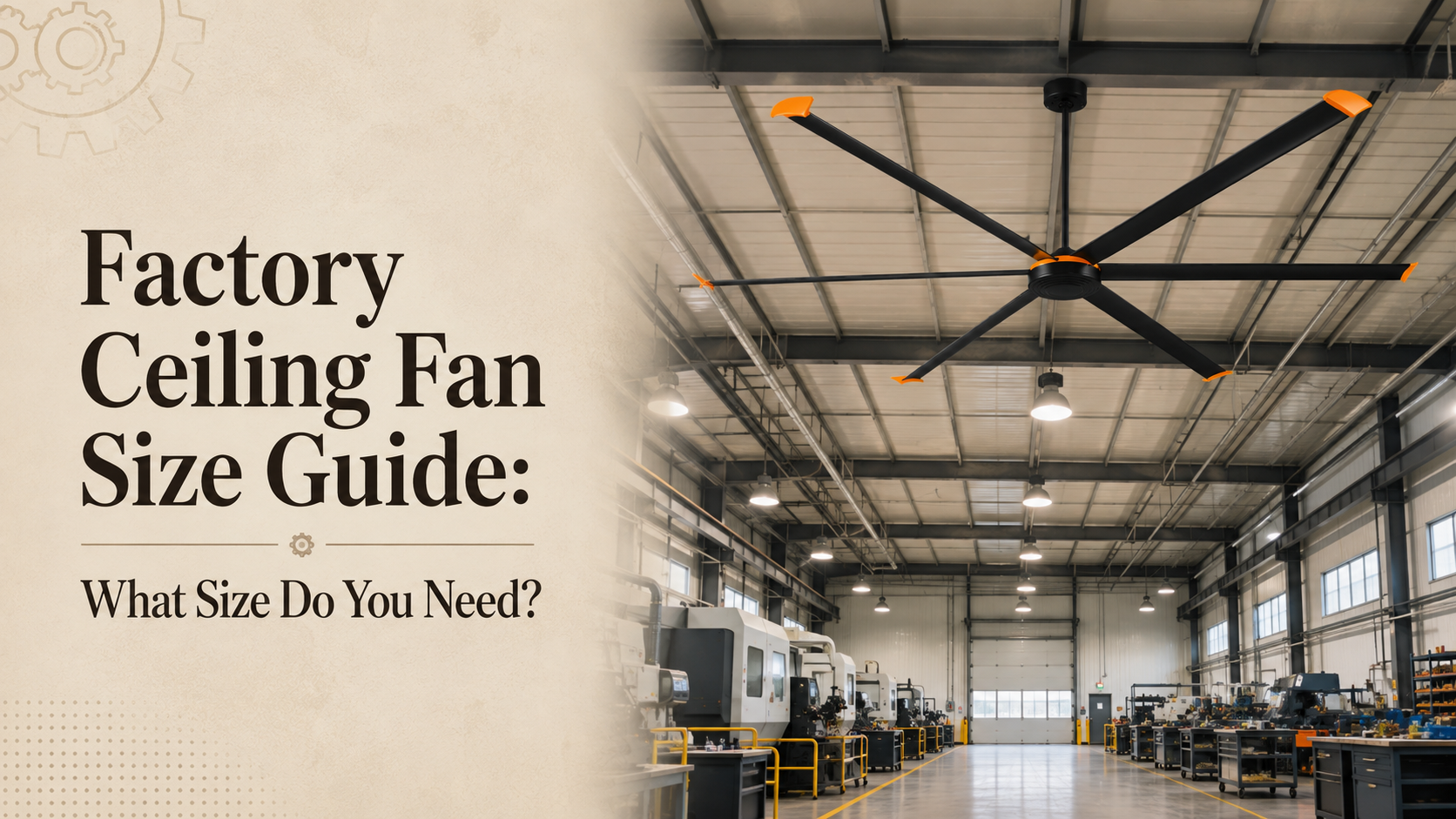


Cooling a warehouse is not just about installing the biggest fan you can find. Large industrial ceiling fans work best when airflow, CFM, ceiling height, work zones, racks, and fan placement are considered together.
Parrot Uncle is a U.S.-based home brand best known for large ceiling fans, and Hvls fans solutions that improve comfort and elevate the look of everyday spaces.The goal is simple. Move useful air through the areas where employees actually work.
Why Warehouses Are Hard to Cool
Warehouses often have large roofs, high ceilings, loading doors, machinery, lighting, and wide open areas. All of these factors can affect indoor comfort.
Airflow may also be uneven. A loading area near an open door may have plenty of air movement, while a packing station deeper inside the building feels hot and still.
Tall racks and equipment can make the problem worse by interrupting airflow.
That is why warehouse cooling should be planned around actual working conditions instead of square footage alone.
What Large Industrial Ceiling Fans Actually Do
A ceiling fan does not cool the air like an air conditioner.
Instead, it moves air across people and through the building. Moving air can improve comfort because it helps the body release heat more effectively.
This is especially useful in large warehouses where cooling the entire building with air conditioning may be difficult or expensive.
Large industrial ceiling fans can also help reduce stagnant areas and improve overall air circulation.
However, they should be viewed as part of the cooling strategy, not as a replacement for air conditioning or ventilation when those systems are needed.

Focus on Work Zones First
A 20,000 square foot warehouse does not necessarily need the same amount of airflow everywhere.
Some areas may be used mainly for storage, while others may have employees working for an entire shift.
Start with the occupied areas.
Common priority zones include:
- Packing, picking, assembly, and shipping areas.
- Loading zones and frequently used aisles.
- Workstations near machines or other heat sources.
This approach helps you place fans where airflow can actually improve comfort.

Why CFM Matters
CFM means cubic feet per minute. It describes how much air a fan moves under its rated conditions.
For warehouse ceiling fans, CFM is one of the most useful numbers to compare.
A fan rated at 6,000 CFM and one rated at 13,000 CFM do not provide the same airflow capacity.
However, higher CFM does not automatically mean better performance.
Airflow needs to reach workers.
A high CFM fan above an unused storage area may provide less practical value than a lower CFM fan positioned directly over an active work zone.
This is why CFM and placement should always be considered together.
Air Speed at Worker Level Matters Too
CFM describes total airflow volume, but workers feel air speed.
This is especially important in warehouses with high ceilings.
A fan may move a large amount of air near the roof, but the real question is whether enough air movement reaches the occupied level.
Fan diameter, blade design, speed, mounting height, and nearby obstacles all influence that result.
Do not choose an industrial ceiling fan based only on blade span.
Ceiling Height Changes the Cooling Plan
Two warehouses can have the same floor area but very different air volumes.
For example:
A 10,000 square foot warehouse with a 15 foot ceiling contains about 150,000 cubic feet of space.
A 10,000 square foot warehouse with a 30 foot ceiling contains about 300,000 cubic feet.
The floor area is the same, but the taller building contains twice as much air.
Higher ceilings also increase the distance between the fan and workers.
This is why ceiling height, CFM, and mounting position need to be considered together.
How Much Space Can One Warehouse Fan Cover?
There is no universal rule such as one fan for every 5,000 square feet.
Coverage depends on several factors:
- Fan diameter
- CFM
- Ceiling height
- Mounting height
- Racks and machinery
- Desired air speed
- Building shape
An open warehouse gives airflow more room to spread.
A warehouse filled with tall pallet racks may need more fans because those racks break the building into smaller airflow zones.
For this reason, manufacturer performance information is more useful than a simple square footage claim.
One Large Fan or Several Smaller Fans?
One large industrial fan can work well in an open warehouse with a broad central work area.
Several fans may work better in a long building or in a warehouse divided by racks, walls, or different workstations.
| Warehouse Layout | Practical Fan Approach |
|---|---|
| Large open floor | One or more large fans |
| Long narrow building | Multiple fans along the work area |
| Tall rack aisles | Separate airflow zones |
| Several packing stations | Fans placed near occupied areas |
| Mixed storage and work zones | Prioritize work areas |
The best layout follows the way the warehouse is actually used.
Do not place fans only according to visual symmetry.

Use Multiple Fan Speeds
Warehouse cooling needs change during the day.
Morning conditions may be comfortable while afternoon temperatures become much warmer.
A loading area may also need stronger airflow when doors are open and activity is high.
Multiple speed settings let you adjust airflow instead of running every fan at maximum speed all day.
This can improve comfort and give operators more control over the building environment.
More Airflow Is Not Always Better
Maximum fan speed is not automatically the best setting.
Workers directly below a fan may experience very strong airflow, while workers farther away still feel little movement.
That usually means the airflow plan needs adjustment.
The goal is not to create the strongest possible breeze.
The goal is to create comfortable and reasonably even air movement across occupied areas.
This is especially important around paperwork, packaging, and lightweight materials that can be disturbed by excessive airflow.
Use Ceiling Fans With HVAC When Available
Air conditioning and industrial ceiling fans do different jobs.
Air conditioning lowers indoor air temperature and may also control humidity.
Ceiling fans circulate that conditioned air and create additional air movement around workers.
In warehouses that already use HVAC, large ceiling fans can help distribute air more effectively across large spaces.
Fan placement should still be coordinated with supply vents, return air locations, and other building systems.
Ceiling Fans Do Not Replace Ventilation
Air circulation and ventilation are not the same thing.
A ceiling fan moves existing indoor air.
It does not automatically remove welding fumes, dust, vehicle exhaust, chemical vapors, or other contaminants.
If a warehouse has air quality hazards, proper exhaust or ventilation systems may be required.
Large industrial ceiling fans can support comfort and circulation, but they should not be treated as a substitute for required ventilation.
Pay Attention to Racks and Equipment
Tall racks can significantly change airflow.
A fan positioned over an open aisle may provide strong air movement in that area while airflow behind several rows of racks remains weak.
Large machinery can have a similar effect.
Before installing fans, map the major obstacles inside the warehouse.
Look at both the floor and the ceiling.
Racks, beams, ducts, lighting, sprinklers, heaters, cranes, and other equipment can influence where a fan can safely and effectively operate.

Do Not Ignore Sprinkler Systems
Large industrial ceiling fans must be coordinated with sprinkler systems.
Fan diameter, mounting location, vertical clearance, and shutdown requirements may affect how a fan can be installed in a sprinkler protected warehouse.
This is especially important for large diameter fans.
The final installation should follow applicable building requirements, fire protection requirements, and manufacturer instructions.
Moving a fan slightly to avoid one obstacle may create a new problem with another overhead system.
CFM per Watt Can Help Compare Efficiency
Warehouse fans may run for many hours each day, so efficiency is worth checking.
CFM per watt compares airflow with electrical power use.
A higher value generally means the fan produces more airflow for each watt under the stated test conditions.
However, efficiency should not replace airflow capacity as the first consideration.
A very efficient fan that does not move enough air for your work zone is still the wrong choice.
Start with the airflow requirement, then compare efficiency between suitable options.
How to Plan Warehouse Cooling
A simple airflow plan can make fan selection much easier.
Start by recording:
- Warehouse length and width
- Ceiling height
- Work zones
- Rack locations
- Loading doors
- Major equipment
- HVAC locations
- Overhead obstructions
Next, divide the warehouse into areas that actually need airflow.
Then compare industrial ceiling fans based on CFM, blade span, mounting requirements, fan speeds, motor type, and location rating.
This method is more useful than asking how many fans are needed based only on total square footage.
72 Inch 84 Inch Arlene HVLS Large Ceiling Fan with LED
The Parrot Uncle 72 Inch 84 Inch Arlene HVLS Large Ceiling Fan is designed for larger spaces that need both air circulation and overhead lighting. Current specifications list six aluminum blades, a 50 watt DC motor, six speeds, reversible operation, remote control, timer and memory functions. Published airflow is 5,930 CFM for the 72 inch version and 5,840 CFM for the 84 inch version. It is intended for dry spaces including warehouses, factories, garages, and gyms.
The integrated LED is another important feature. The current product specifications list 6,609 lumens at 6500K, and the fan includes 10 inch and 24 inch downrods. This type of fan can work well over packing areas, workshops, or other defined zones where lighting and airflow are both needed. The final size should be selected according to available ceiling space, work zone layout, and nearby obstructions.

96 Inch Industrial DC Motor Ceiling Fan with 6 Blades
The Parrot Uncle 96 Inch Industrial DC Motor Ceiling Fan focuses more heavily on airflow. Current specifications list a 96 inch blade span, six aluminum blades, six speeds, a reversible 35 watt DC motor, remote control, timer and memory functions, and airflow of 12,859 CFM. It is designed for dry locations including warehouses, factories, garages, and other large spaces.
This model does not include an integrated light, which can be useful in warehouses that already have dedicated commercial lighting. Its higher published airflow makes it better suited to larger circulation zones, provided there is enough ceiling space for the 96 inch blade span. Placement should still account for ceiling height, racks, sprinklers, lighting, and structural components.

Final Thoughts
Large industrial ceiling fans can improve warehouse comfort by moving air through active work areas.
Focus on CFM, ceiling height, work zones, racks, and placement instead of fan size alone.
The best cooling plan is the one that delivers useful airflow where workers actually need it.