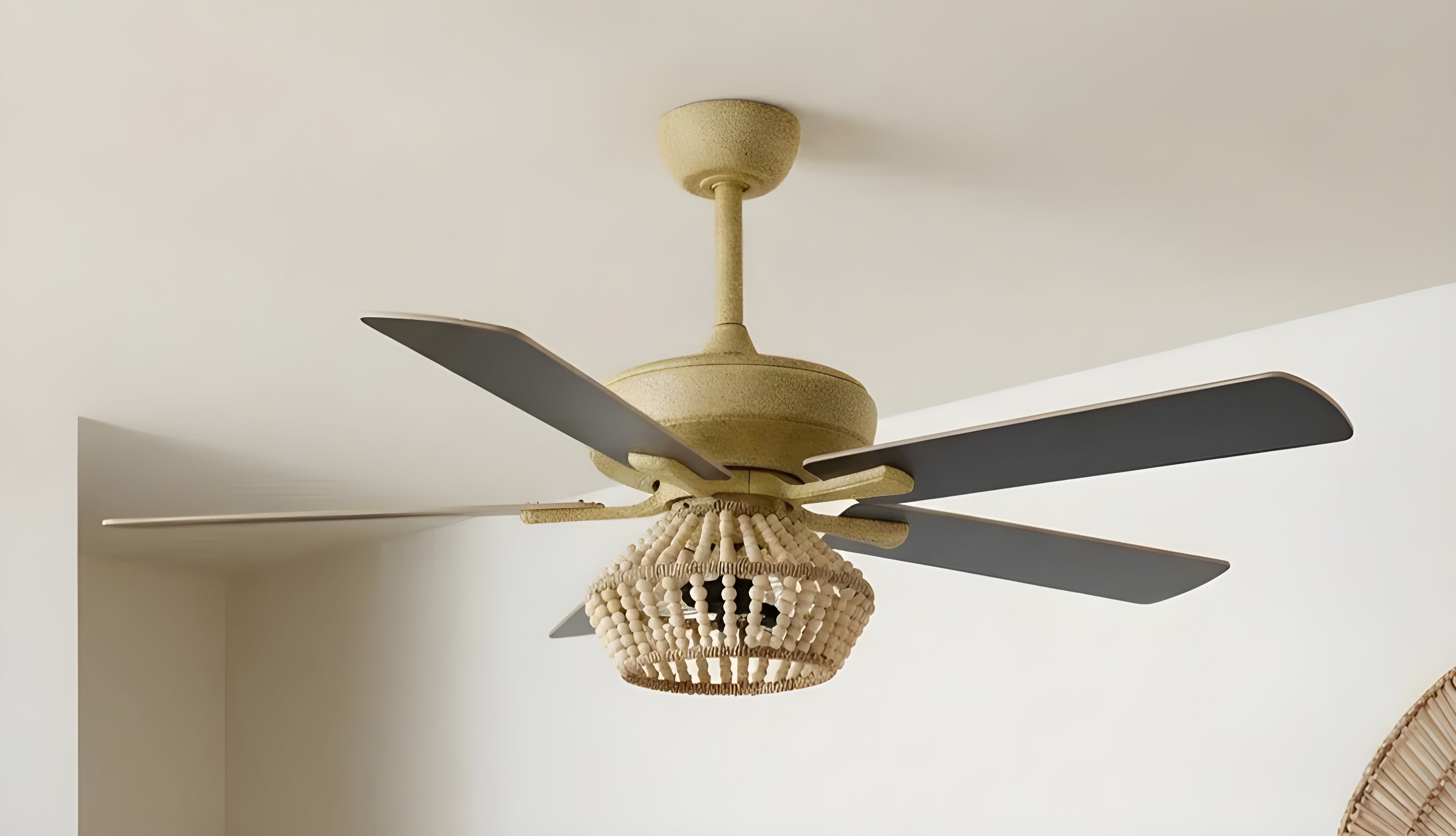


If you want the clearest answer first, a 52-inch ceiling fan is usually better for a living room. Standard size guidance puts 50 to 54-inch fans in the range for rooms about 225 to 400 square feet, and federal energy guidance says larger rooms should use fans that are 52 inches or more. That is why 52 inches is often the safer starting point for a main living room. It also happens to be the most popular ceiling fan size in current national guidance.
A 42-inch ceiling fan is not wrong. It can still be the better fit in a smaller living room, a condo living area, a den that functions like a living room, or a room where the ceiling is lower and the fan needs to look lighter. But if the question is which size works better for a typical American living room, 52 inches has the stronger case.
Parrot Uncle is a U.S.-based home brand best known for ceiling fans, and lighting solutions that improve comfort and elevate the look of everyday spaces. Ceiling fans can let you raise the thermostat by about 4 degrees without reducing comfort, but that comfort gain depends on fan size and placement. Larger blades move more air at lower velocities, and that multiple fans often work better in rooms longer than 18 feet. In other words, fan size changes how the room feels in real use, not just how it looks.

Short answer
For most living rooms, choose a 52-inch ceiling fan. Choose a 42-inch fan only when the room is clearly on the smaller side, or when the layout and ceiling conditions make a smaller fan the more balanced option. If you are unsure and your living room is not obviously compact, 52 inches is usually the smarter choice.
Here is the quick comparison.
| Question | 42-inch ceiling fan | 52-inch ceiling fan |
|---|---|---|
| Better for a compact living room | Usually yes | Sometimes too large visually |
| Better for a standard main living room | Less often | Usually yes |
| Better for an open plan living area | Rarely | More often |
| Better for rooms over about 225 square feet | Usually no | Usually yes |
| Feels lighter on the ceiling | Yes | Less so |
| Safer default choice for most living rooms | No | Yes |
The table reflects current size guidance that places 36 to 42-inch fans in smaller room ranges and 50 to 54-inch fans in the 225 to 400 square foot range, along with federal guidance that points larger rooms toward 52 inches or more.
What really decides the better size
1. Room size comes first
The first thing to check is square footage. Current national guidance says rooms up to 75 square feet usually use 29 to 36-inch fans, rooms from 76 to 144 square feet use 36 to 42-inch fans, rooms from 144 to 225 square feet use 44-inch fans, and rooms from 225 to 400 square feet use 50 to 54-inch fans. A second federal source gives a simpler version of the same rule and says rooms up to 225 square feet can use 36 or 44-inch fans, while larger rooms should use 52 inches or more.
That is the core reason 52 inches usually wins this comparison. A 42-inch fan sits in the small to medium room zone. A 52-inch fan sits in the larger room zone. Since many living rooms are larger than bedrooms and often fall somewhere around or above 225 square feet, the standard recommendation naturally leans toward 52 inches instead of 42.
This is also why a lot of quick online advice can be misleading. It often treats all living rooms as if they are the same size. They are not. A small apartment living room and a large suburban family room are both called living rooms, but they do not need the same fan. If your room is clearly below the larger-room threshold, 42 inches stays in the conversation. If the room is at or above that threshold, 52 inches becomes the more natural answer.
There is also a simple geometry point worth noting. By basic math, a 52-inch fan sweeps about 53 percent more circular area than a 42-inch fan. That does not guarantee 53 percent more airflow, because motor design, blade pitch, and mounting still matter. But it helps explain why a 52-inch fan usually covers a broader seating zone and feels more appropriate in a larger living room.
2. Ceiling height and mounting matter more than most buyers think
The next factor is ceiling height. Standard guidance says the fan should be mounted in the middle of the room, at least 7 feet above the floor, and at least 18 inches from the walls. If ceiling height allows, 8 to 9 feet above the floor is the ideal range for airflow.
That is important because the same size fan can behave differently depending on how it is mounted. Standard downrod mounts usually give the fan better working distance from the ceiling. By contrast, low-profile or hugger fans are designed for ceilings under 8 feet, but national guidance also says they do not move as much air as regular fans because the blades sit closer to the ceiling. So a 52-inch fan mounted too tightly to the ceiling may not perform as well as buyers expect, while a well-positioned fan can do a much better job.
This is one reason the 42-inch versus 52-inch debate should never be reduced to diameter alone. A 42-inch fan in the right mounting position may feel more effective than a poorly placed larger fan. But if you have the ceiling height to mount a 52-inch fan correctly, it usually gives the living room broader and more useful coverage. That is especially true if the room is open, long, or used by several people at once.
3. Airflow is more than blade span
A lot of articles stop at size, but real fan performance is more complicated. Federal guidance says larger blades move more air at lower velocities, which is helpful in larger areas. At the same time, actual airflow still depends on the motor, the blade design, the blade pitch, and the mounting style. That means a 52-inch fan often has an advantage, but not every 52-inch fan will beat every 42-inch fan in a real-world spec sheet.
Current Parrot Uncle product pages make that clear. One 42-inch model is listed at 2652 CFM for medium rooms up to 175 square feet, while one current 52-inch model is listed at 5800 CFM for rooms up to 350 square feet. The size difference matters, but the real takeaway is that fan size and room rating usually line up together on the product page. That is a better way to shop than looking at blade span by itself.
This is also why 52 inches is usually the better choice for a living room even when the exact airflow number changes from one model to another. A living room usually needs wider coverage, not just a breeze directly under the fan. The larger fan is more likely to support that broader comfort zone, and the current product pages for 52-inch models are clearly aimed at larger rooms for exactly that reason.

When a 42-inch ceiling fan is the better choice
A 42-inch ceiling fan makes sense when the living room is truly compact. Think of a small condo living room, a narrow townhouse sitting room, or a den that is used as a living room but does not have a large open footprint. Standard size guidance places 36 to 42-inch fans in rooms from 76 to 144 square feet, and current Parrot Uncle product information for one 42-inch model rates it for medium rooms up to 175 square feet. That puts 42 inches in the small-room to small-medium-room category, not the standard larger living room category.
A 42-inch fan can also be the better option when the room is visually tight. If the ceiling is lower, the furniture sits close to the walls, or the room already has beams, a large media wall, or other strong ceiling elements, a smaller fan can feel more balanced. National guidance on clearance and ideal mounting height supports that idea because the fan has to fit the room physically as well as stylistically.
Another good case for 42 inches is when the living room is not really a full-size family room. Some homes have formal living rooms, front sitting rooms, or multi-use spaces that are called living rooms but behave more like medium rooms. In those cases, a 42-inch fan can be enough, especially if the airflow spec is solid and the room does not need broad coverage. The current 42-inch Gladys model from Parrot Uncle is a good example of that kind of product. It is positioned for bedrooms and living rooms, but only up to 175 square feet.
A final reason to consider 42 inches is visual comfort. A smaller fan can look less dominant in a compact room. If the space needs air movement but you do not want the fan to take over the ceiling, 42 inches can be the better fit. That does not make it the better choice for most living rooms. It just makes it the right choice for smaller or more delicate ones.
When a 52-inch ceiling fan is the better choice
A 52-inch ceiling fan is usually the better choice when the living room is the main living space in the home. If the room is used every day, has a broad seating arrangement, or opens into the kitchen or dining area, 52 inches fits the way the space actually functions. Standard size charts place 50 to 54-inch fans in rooms from 225 to 400 square feet, and federal guidance says larger rooms should use 52 inches or more. That lines up very closely with what many people mean when they say living room.
A 52-inch fan is also the better choice when the room is open plan. In newer homes, the living room often shares air with nearby spaces, which makes broad airflow more useful. The larger blade span helps the fan cover more of the occupied area, and federal guidance also notes that larger blades move more air at lower velocities, which is useful when you want comfortable circulation without an aggressive breeze.
This is why 52 inches has become the default answer for so many American buyers. National guidance specifically says the 52-inch model is the most popular size, and that popularity makes sense. It sits right in the overlap between practical room coverage, standard ceiling heights, and everyday living room needs. It is large enough to work in many main living spaces without becoming so large that installation gets difficult in a normal home.
A 52-inch fan is especially useful when the room gets warm in one section, when sunlight hits one side of the room, or when several people gather there regularly. In those situations, you do not just want a breeze near the center of the room. You want a wider comfort zone. That is the problem a 52-inch fan is better built to solve.
Why 52 inches usually wins this comparison
If you step back and look at the guidance as a whole, 52 inches is the better general answer for a living room because it aligns with the room sizes most living rooms actually fall into. A 42-inch fan belongs to the smaller-room side of the sizing chart. A 52-inch fan belongs to the larger-room side. Since living rooms are often larger than bedrooms and more open than home offices, 52 inches usually lands in the right place.
There is also a practical comfort reason behind that. A living room is rarely used by one person standing in one fixed spot. People spread out across sofas, chairs, coffee table areas, and sometimes into the edge of an adjacent room. The wider working area of a 52-inch fan helps it cover that kind of real seating pattern better than a 42-inch model can. Federal guidance on larger blades moving more air and larger rooms using 52 inches or more supports that conclusion.
Still, the most honest version of the answer is not that 42 inches is wrong. It is that 52 inches is the better default, while 42 inches is the better exception. If your living room is compact or visually tight, 42 inches can absolutely be the right call. But if you are writing for the average buyer asking about the average living room, 52 inches is the size that fits the official guidance better.
Common mistakes people make
One common mistake is choosing by room label instead of room size. People hear the word living room and assume one answer fits all. But national guidance does not work that way. It starts with square footage because that is more reliable than the room name. A small apartment living room and a large open family room should not be treated the same.
Another common mistake is ignoring height and clearance. Standard guidance says the blades should be at least 7 feet above the floor, 8 to 9 feet is ideal when possible, and the fan should sit at least 18 inches from the walls. If the fan is too tight to the ceiling or too close to nearby surfaces, performance suffers. That is one reason low-profile fans move less air than standard-mounted fans.
A third mistake is assuming bigger always means better. Bigger is often better for a living room, but only when the room really supports it. If the room is small, a 52-inch fan can feel oversized. If the room is large, a 42-inch fan can feel undersized. The right choice comes from matching the fan to the room, not chasing the bigger number by default.
From the Parrot Uncle point of view
Parrot Uncle's current product lineup supports the same basic conclusion. Its current 42-inch Gladys model is presented as a modern DC motor fan for bedrooms or living rooms up to 175 square feet, with 2652 CFM airflow, a 20W integrated LED, six speeds, a remote, and a downrod mount. That is a useful product, but it is clearly positioned for medium spaces rather than a full-size main living room.
By contrast, the current 52-inch Dinah model is described as a large-room fan for up to 350 square feet, with 5800 CFM airflow, a 40W DC motor, six speeds, an 18W integrated LED, and a downrod mount. That is much closer to what most buyers expect from a living room ceiling fan. The room-size language alone makes the distinction very clear.
That is why the brand angle actually helps here. Instead of keeping the comparison abstract, the current product pages show how manufacturers position these two sizes in real use. The 42-inch option is for smaller spaces. The 52-inch option is for larger living areas. That matches the national guidance almost exactly.
Two Parrot Uncle products that show the difference
Parrot Uncle 42 Inch Gladys Modern Black LED Ceiling Fan with Remote Control
This model is a good example of when a 42-inch fan makes sense. The current product page says it is designed for medium rooms up to 175 square feet and suitable for a bedroom or living room. It uses a DC motor, has six speeds, includes a remote with timer and memory function, offers reversible operation, and includes a 20W LED with stepless dimming and three color temperature options. Its listed airflow is 2652 CFM, and the page also lists a 5-year motor warranty plus 2-year coverage for the controller and light.
Who is it best for? It is the better fit for a compact living room where you want a quiet, modern fan that does not take over the ceiling. If the room is more like a smaller sitting room or a medium condo living area, this kind of 42-inch fan can be the right answer. It proves that 42 inches is not too small for every living room. It is just more limited in where it works best.

Parrot Uncle 52 Inch Dinah Modern Downrod Mount Ceiling Fan with Remote Control and LED Light
This model is a good example of why 52 inches is usually the better living room choice. The current product page says it is built for large rooms up to 350 square feet and lists the living room as one of its intended spaces. It uses a 40W DC motor, has six speeds, comes with a multi-function remote, includes an 18W integrated LED at 2000 lumens, and is rated at 5800 CFM. It also ships with 5-inch and 10-inch downrods for more installation flexibility.
Who is it best for? It is the stronger pick for a standard main living room, especially one with an open feel or a wider seating layout. Compared with the 42-inch model above, it is positioned for a much larger room range and much stronger airflow. That does not mean every 52-inch fan on the market will perform exactly like this one. It means this is the kind of spec profile that explains why 52 inches is usually the better answer for the living room question.

A quick side by side look
| Feature | Parrot Uncle 42 Inch Gladys | Parrot Uncle 52 Inch Dinah |
|---|---|---|
| Blade span | 42 inch | 52 inch |
| Suggested room size | Up to 175 sq ft | Up to 350 sq ft |
| Airflow | 2652 CFM | 5800 CFM |
| Motor type | DC | DC |
| Speeds | 6 | 6 |
| Light kit | 20W LED, 2400 lumens | 18W LED, 2000 lumens |
| Best use | Compact living room or medium room | Standard to large living room |
This comparison comes directly from the current product pages and makes the size difference much easier to understand in practical terms.
How to choose in five minutes
Start with the room size. If the living room is clearly under about 175 square feet, a 42-inch fan can be reasonable. If the room is around 225 square feet or above, standard guidance points strongly toward the 50 to 54-inch range, and federal guidance says larger rooms should use 52 inches or more.
Next, check the ceiling height and mounting. Make sure the fan can sit at least 7 feet above the floor, with 8 to 9 feet ideal when possible, and remember that low-profile mounting reduces airflow compared with a standard-mounted fan.
Then compare the actual product specs. Look at room rating, airflow, motor type, and mounting style. That is where the real difference between a good 42-inch fan and a good 52-inch fan becomes clear. Current Parrot Uncle product pages show exactly how that works in practice.
Final verdict
So, which is better for a living room, a 52-inch or 42-inch ceiling fan?
For most living rooms, the better choice is 52 inches. It matches the standard room-size guidance better, it is the more natural fit for larger everyday spaces, and it usually gives broader coverage across the seating area that makes a living room different from a bedroom or office. If your room is a standard main living room, that is the size I would start with.
A 42-inch fan is better only when the living room is clearly smaller, tighter, or more like a medium multipurpose room than a full-size family space. It can still work well in that setting, and current Parrot Uncle product information shows that the brand treats 42 inches as a viable option for living rooms up to 175 square feet.
So the honest answer is simple. If you need a default, choose 52 inches. If the room is clearly compact, or the ceiling and layout argue for a smaller visual footprint, then 42 inches can be the smarter choice. But for the average buyer asking about the average living room, 52 inches is usually better.
FAQ
Q1.Is a 52-inch ceiling fan too big for a small living room?
It can be. If the room is clearly in the small or medium range, a 52-inch fan may feel oversized. Standard guidance keeps 36 to 42-inch fans in smaller rooms and places 50 to 54-inch fans in the 225 to 400 square foot range.
Q2.Can a 42-inch ceiling fan work in a living room?
Yes. It can work in a smaller living room, condo space, or den-like sitting room. One current Parrot Uncle 42-inch model is rated for living rooms up to 175 square feet.
Q3.Does a 52-inch fan always move more air than a 42-inch fan?
Not automatically in every product line, but larger blades generally move more air at lower velocities, and current Parrot Uncle examples show a large-room 52-inch model with much higher listed airflow than the 42-inch model.
Q4.What if my living room is very long?
Federal guidance says rooms longer than 18 feet often work better with multiple fans rather than relying on one fan alone.