

Bathroom vanity lighting is one of those decisions that feels “decorative” until you live with it. The wrong setup can leave harsh shadows under your eyes, glare in the mirror, or a room that looks great in photos but feels dim at 6 a.m. The right setup makes daily routines easier and makes the whole vanity wall look more finished.
From Parrot Uncle’s point of view, the best choice depends on two things: how you use the vanity (makeup, shaving, contacts, quick hand-wash) and what your wall and wiring will realistically support. This guide compares a light above the mirror (often a bath bar) with side sconces, then walks through sizing, light quality, and the small details that make a big difference.
Parrot Uncle is a U.S.-based home brand specializing in vanity lights, chandeliers, and a wide range of stylish furniture that bring comfort and character to every space. With years of experience in lighting and home décor, we are committed to blending practical functionality with distinctive design. In this article, we’ll draw on Parrot Uncle’s professional expertise to dive into one key question: Vanity Light Above Mirror vs Side Sconces: Which Looks Better and Works Better?

1) What’s the Best Vanity Lighting for Real Life?
What good vanity lighting actually does
At the vanity, you’re not lighting a room—you’re lighting a face. The goal is even light from both sides so you don’t get strong shadows on one cheek or under your brow. That’s why many lighting guides treat the vanity as task lighting first, style second.
A simple way to judge a setup is this: stand at the mirror and ask whether the light makes your face look even and natural, without hard lines under your eyes or a bright hotspot at the top of the mirror.
Above-mirror vanity light: why it’s so common
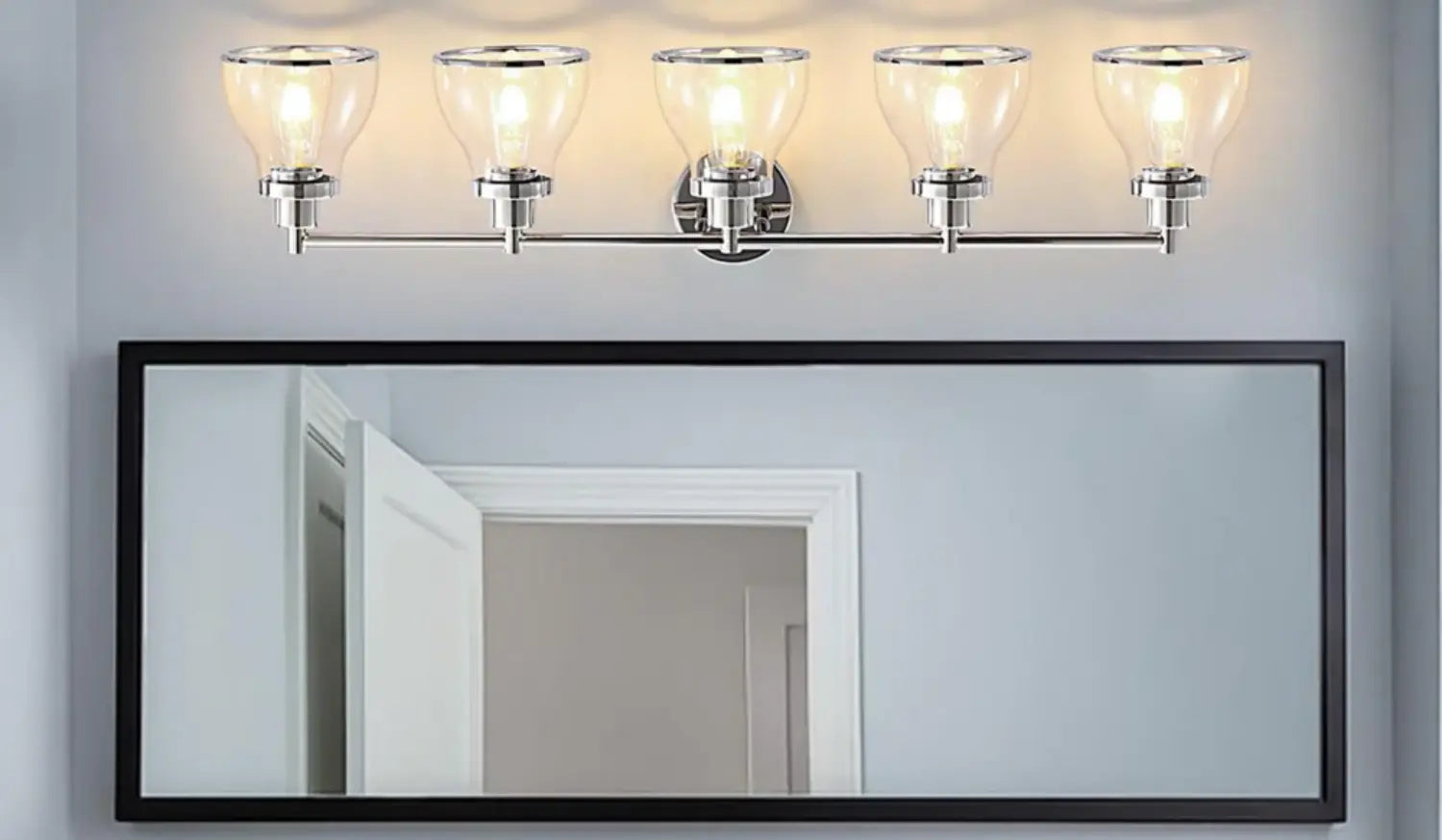
A light above the mirror is popular because it’s straightforward:
-
It usually uses one junction box centered over the sink.
-
It’s easy to align with one mirror.
-
It gives a clean “finished” look, especially with a modern bar fixture.
For many bathrooms, especially small powder rooms, it’s the easiest upgrade from a builder-style fixture.
But functionally, above-mirror lighting often creates more downward shadows than people expect—especially if the fixture is mounted too high or the bulbs are exposed.
Side sconces: why designers keep recommending them
Side sconces are often called the most flattering option because they put light closer to face level from both sides. The American Lighting Association’s general guidance (as quoted in a widely read design guide) places side sconces around 65–70 inches from the floor, roughly at eye level, to reduce shadows across the face.
This is why side sconces tend to “work better” for:
-
makeup and skincare
-
shaving
-
anyone who hates harsh overhead glare
So…which looks better?
“Better-looking” depends on the room and mirror style:
-
Above-mirror lights often look best when you have one mirror per sink and you want a clean, horizontal line. They also pair well with wide mirrors and modern bar fixtures.
-
Side sconces often look best when you want a more built-in, higher-end feel—especially with framed mirrors, medicine cabinets, or a vanity wall that needs vertical balance.
A quick visual rule:
If your vanity wall already has strong horizontal lines (wide mirror, long countertop, backsplash), side sconces add balance. If the wall needs simplification (busy tile, multiple accessories), one clean light above the mirror can calm everything down.
At-a-glance comparison (looks + function)
| Setup | Works better for | Usually looks better when | Typical trade-offs |
|---|---|---|---|
| Light above mirror | General grooming, quick routines | One mirror per sink; you want a clean, simple line | More face shadows; glare risk if bulbs are exposed |
| Side sconces | Makeup/shaving; most even face lighting | You want a custom look; framed mirror/medicine cabinet | More planning: wiring, spacing, wall room |

2) Above Mirror vs Side Sconces: Placement, Direction, and Sizing
Mounting heights people actually use (simple and measurable)
There’s no single “code height,” but there are common placement targets that show up consistently in installation guidance.
Above-mirror fixture height (common guideline): Many installers place the center of an over-mirror fixture around 75–80 inches from the finished floor, and often a few inches above the top of the mirror, depending on mirror height and ceiling height.
Side sconce height (ALA-style guidance): Around 65–70 inches from the finished floor (about eye level).
Spacing side sconces: Many practical guides suggest spacing sconces roughly 36–40 inches apart (center to center) for common vanity widths, adjusting for mirror size.
Use these as starting points, then adjust for:
-
very tall mirrors
-
very short or very tall household members
-
ceiling height and visual balance
Upward vs downward: which direction is better?
A lot of vanity fixtures can be mounted with bulbs facing up or down. In real bathrooms:
-
Downward-facing tends to work better for task lighting because it puts more light onto the face and counter and usually reduces ceiling bounce.
-
Upward-facing can soften the room by reflecting light off the ceiling, but it can also highlight ceiling texture and sometimes feels less “focused” for grooming.
A practical approach we recommend at Parrot Uncle:
-
If the vanity light is your main grooming light, face it down.
-
If you already have strong ceiling lighting (recessed lights) and want the vanity fixture to feel more ambient, up can work—especially with frosted shades.

Choosing the right fixture width (so it doesn’t look “off”)
This is where people get stuck: should the fixture match the mirror width? The most useful answer is proportional, not exact.
A common design rule is to choose a vanity light that’s roughly 70–80% of the mirror’s width, and keep the fixture no wider than the mirror.
That proportion tends to look balanced in real bathrooms because:
-
it keeps the light visually connected to the mirror
-
it avoids a fixture that “hangs past” the mirror edges (which can look accidental)
Side sconces sizing
For side sconces, width is less important than vertical scale. What matters is that the sconce height fits the mirror height and doesn’t crowd the mirror edge. If you have a narrow wall, choose a slimmer sconce profile.
How many lights do you need (2-light vs 3-light vs 4-light)
Instead of guessing, start with what you’re lighting:
-
a single sink
-
a double vanity
-
one wide mirror spanning two sinks
If you’re going above the mirror, the fixture needs enough output to cover the mirror width without hotspots. Many people choose a 3- or 4-light bar simply because it spreads light more evenly across wider mirrors.
For double vanities, two common solutions look intentional:
-
one light + one mirror per sink (symmetry is easy)
-
two sconces flanking a wide mirror (clean and upscale)
A practical “choose your layout” table
| Your bathroom situation | Best “works better” pick | Best “looks better” pick |
|---|---|---|
| Tight wall space next to mirror | Above-mirror bar | Above-mirror bar |
| You do makeup/shaving daily | Side sconces | Side sconces |
| Existing single junction box above sink | Above-mirror bar | Above-mirror bar (unless rewiring) |
| Large framed mirror / medicine cabinet | Side sconces | Side sconces |
| Wide mirror over double vanity | Side sconces or two bars | Depends: modern = bars; classic = sconces |
| Low ceiling / glare-sensitive | Side sconces (softer on eyes) | Either, with diffusers |

3) Trends, Light Quality, and What to Buy (So It Looks Good and Performs Well)
What vanity lighting trends are actually sticking
Trends change, but a few shifts have been consistent in recent bathroom updates:
-
Cleaner, slimmer vanity bars (often integrated LED) for a simple line over the mirror
-
Matte black and mixed-metal finishes to match faucets and hardware without forcing everything to be identical
-
Better “light quality” shopping (people asking about brightness, color temperature, dimming, and glare—not just style)
At Parrot Uncle, we also see more customers choosing fixtures that solve a real pain point: “I hate shadows,” “my light is too yellow,” “LED flickers on my dimmer,” or “this bathroom always feels dark.”
Brightness: how much light is enough
A useful reference point: one buyer’s guide cites the American Lighting Association recommending a minimum of about 1,600 lumens at the vanity (roughly comparable to two 60W incandescent bulbs), with some flexibility depending on LED fixture efficiency and overall bathroom lighting.
What this means in plain terms:
-
If your vanity light is the main grooming light, aim for a setup that gets you into that general range.
-
If you have strong layered lighting (recessed lights + shower light + vanity), you can run lower at the vanity and rely on the whole system.
Color temperature (Kelvin): pick what matches your routine
Color temperature is the “warm vs cool” feel of the light.
A practical bathroom approach is:
-
2700K–3000K: warm and relaxing (popular in powder rooms and for a softer look)
-
3500K–4000K: neutral/clean (often the easiest “everyday bathroom” range)
-
4000K–5000K: brighter and more “daylight-like” for detail work (good for makeup/shaving, but can feel stark late at night)
If you’re unsure, a safe default for most U.S. homes is around 3000K–3500K for a natural feel—unless you specifically want daylight-style accuracy for makeup.
CRI (color accuracy): the “small spec” that matters a lot
CRI is a 0–100 scale that describes how accurately a light source shows colors compared with a reference. Higher CRI makes skin tones and makeup shades look more true.
Many lighting and makeup-focused guides recommend CRI 90+ for vanity/grooming tasks because it reduces color distortion.
If you’ve ever done makeup in your bathroom, walked outside, and thought “why does my foundation look different?”—CRI is often part of the reason.
Glare control: clear vs frosted glass
If you can see the bare LED or filament when you look in the mirror, you’re more likely to get glare.
For most bathrooms, a diffuser (frosted glass, opal shade, or a lens that hides the LED points) creates a softer result and makes the mirror more comfortable to use.

Dimming (and avoiding flicker)
Flicker and buzzing are usually not “random.” They’re often compatibility issues:
-
the fixture isn’t actually dimmable
-
the dimmer type doesn’t match the LED driver
-
the load is too small for the dimmer to behave well
Planning tip: if dimming matters to you, choose a fixture that clearly states it’s dimmable and follow the recommended dimmer/control type.
Damp-rated vs wet-rated: what bathrooms usually need
Bathrooms are humid, which is why fixture rating matters.
UL location guidance describes damp locations as areas subject to moisture/humidity but not direct water exposure, and wet locations as places with direct water contact or heavy spray.
Most vanity lights near a sink are typically selected as damp-rated; areas inside a shower zone or where spray can hit the fixture may call for wet-rated fixtures. Always follow the product rating and your local requirements.
A buying checklist we use at Parrot Uncle
If you want a fast, low-regret decision, confirm these before you buy:
-
Layout: above-mirror vs side sconces (based on wall space and routine)
-
Height: above-mirror commonly 75–80" to center; sconces around 65–70" to center
-
Width: about 70–80% of mirror width for a bar
-
Brightness: target a vanity setup around the “minimum useful” range if it’s your main task light
-
Light quality: CRI 90+ if grooming accuracy matters
-
Color temp: pick a Kelvin range that matches how you use the space Rating: damp-rated for humid areas; wet-rated if exposed to direct spray
-
Dimming plan: confirm compatibility to avoid flicker

FAQ
1) Is a vanity light above the mirror “good enough,” or should I always do sconces?
Above-mirror lights can work great, especially in smaller bathrooms or when you’re using existing wiring. But side sconces often give more even face lighting because they sit closer to eye level. A common ALA guideline places sconces around 65–70" high for that reason.
2) What height should vanity lights be mounted?
Common installer targets place an above-mirror light around 75–80" from the floor to the fixture’s center, while side sconces are often placed around 65–70" (eye level). Adjust based on mirror height and who uses the bathroom most.
3) Should vanity lights face up or down?
If the vanity light is doing most of the grooming work, down-facing usually performs better for task lighting. Up-facing can add softer ambient light but may feel less focused. The best choice depends on glare sensitivity, ceiling reflectance, and whether you already have good overhead lighting.
4) How wide should a vanity light be compared to the mirror?
A common proportion rule is choosing a fixture about 70–80% of the mirror width and keeping it no wider than the mirror. That tends to look balanced and keeps light centered where you need it.
5) What’s the best bulb color for bathroom vanity lighting?
For most homes, neutral ranges around 3000K–4000K work well. If makeup accuracy is a priority, many guides recommend a brighter, more daylight-like range (often 4000K–5000K) paired with high CRI.
6) What CRI should I look for in vanity lighting?
If you care about seeing true skin tones and makeup shades, CRI 90+ is a common recommendation. It reduces “weird” color shifts that can happen under low-CRI lighting.